
Exodontia.info
Menu
Exodontia.info
✕
info@exodontia.info

TMJ Arthrocentesis (Jaw Joint Washout)

What is Jaw Joint Arthrocentesis?

TMJ / Jaw Joint Arthrocentesis (the washing out of the jaw joint space) is a procedure during which the jaw joint is washed out with sterile saline ± anti-inflammatory steroids, long-acting local anæsthetics, painkillers or collagen components.

TMJ / Jaw Joint Arthrocentesis of the (upper) joint space reduces jaw joint pain by:

  • diluting / flushing out the inflammatory chemicals from the jaw joint
  • increasing mandibular (lower jaw) movements by removing intra-articular adhesions (scarring within the joint space)
  • eliminating the negative pressure within the jaw joint
  • recovering disc and fossa space and improving disc mobility (return the disc of cartilage to its normal position within the joint) which reduces the mechanical obstruction caused by the anterior (forward) position of the disc.

The majority of restricted opening is secondary to upper joint space problems, particularly ‘anchored disc’ phenomenon, where arthrocentesis is particularly beneficial.

TMJ Arthrocentesis
TMJ Arthrocentesis

When is Jaw Joint Arthrocentesis used?

Indications for arthrocentesis are:

  • dislocation of the articular disc ± reduction
  • limitations of mouth opening originating in the jaw joint
  • joint pain and other internal derangements of the TMJ.

What does the treatment involve?

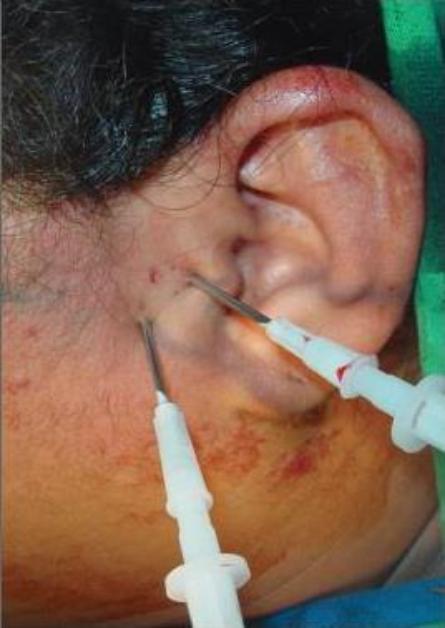
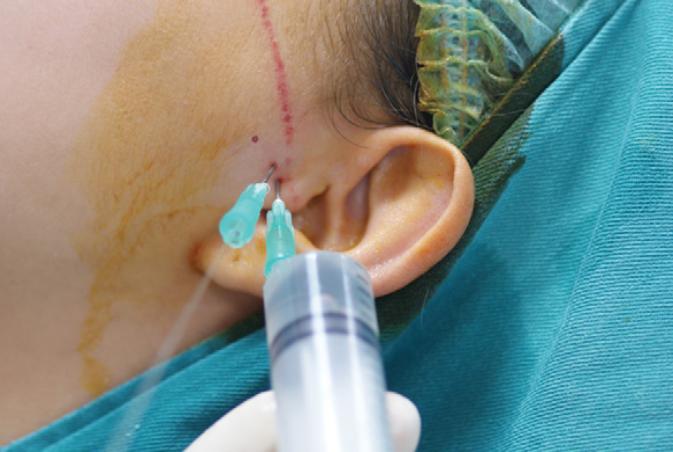
TMJ / Jaw Joint Arthrocentesis usually takes place under a General Anæsthetic – this means you will be asleep for the entire procedure. Whilst you are asleep, two small needles will be inserted into the TMJ / Jaw Joint. One of these needles allows sterile saline to be pumped into the joint under pressure whilst the other needle allows the saline to drain out of the joint.
TMJ Arthrocentesis
Photos showing needles placed within the TMJ for TMJ Arthrocentesis & arthrocentesis taking place (right photo)

While you are asleep, your lower jaw will often be Joint disc back into its normal position and break down any adhesions within the jaw joint.

How will I feel after the operation?

The area in and around the TMJ / Jaw Joint is often uncomfortable for several days after the procedure.

You may find it necessary to take simple painkillers, such as Ibuprofen, during this time.

There will be some swelling in front of your ear.

You may also find it difficult to open your jaw for a few weeks.

Will I need another appointment?

You will need to return a few weeks after surgery to have your jaw joint checked by your surgeon. TMJ / Jaw Joint arthrocentesis is not always successful and even in those people who have an improvement following the procedure, it can take several months for this to occur.

Also, you will need to continue with TMJ / Jaw Joint exercises, physiotherapy, wearing of BRA’s etc.

Rare complications include:

  • Horner syndrome
  • Upper airway compression
  • Para-pharyngeal swelling
  • Variant petro-tympanic fissure
  • Infection of the infra-temporal space
  • Pseudo-aneurysm and arterio-venous fistula
  • Superficial temporal artery aneurysm
  • Trans-articular perforation
  • Intra-cranial perforation & extra-dural haematoma

What are the possible complications?

Complications after puncture of the TMJ depend on the anatomy of the joint and its relations.

Possible complications of TMJ / Jaw Joint Arthrocentesis also depend on the technique used. The complication rate following TMJ / Jaw Joint Arthrocentesis is given as between 2 – 10%.

Complications usually present in the immediate post-operative phase and are mostly associated with fluid collection and vascular injury.

Facial Muscle Weakness (< 1.0%) (temporary / permanent) resulting from injury to the Facial Nerve whilst gaining access to the jaw joint space. The most common problem resulting from this, is the inability to wrinkle the brow, raise the eyebrow or gain tight closure of the eyelids.

Numbness (< 2.5%) (temporary / permanent) of certain areas of skin in the region of the jaw joint and sometimes in more remote areas of the face or scalp.

Bleeding within the jaw joint which cannot be adequately controlled and could require immediate intervention by open joint surgery.

Ear problems (< 9.0%), including inflammation of the ear canal, middle / inner ear infections, vertigo, perforation of the ear-drum and temporary / permanent hearing loss.

Instrument Separation (that is, the needle breaks off within the joint space) which may require open joint surgery.

Facial Scarring from the entry injection.

Damage to the jaw joint surface during the arthrocentesis procedure, usually of a reversible nature but which could permanently affect joint function.

Unsuccessful entry into the jaw joint or inability to accomplish the desired procedure because of limited motion of the jaw joint / scarring.

Worsening of present TMJ symptoms which may require repeat arthrocentesis, arthroscopy or open joint surgery.

Changes in the bite after arthrocentesis which may affect chewing functions. In addition, there may be temporary / permanent limited mouth opening.

Post-operative infection requiring additional treatment.

Adverse / Allergic reactions to any of the medications used in the procedure.

Pre-Auricular Hæmatoma. A blood clot can develop infront of the ear.

Extravasation of fluid from the jaw joint into the surrounding tissues.

Useful Articles & Websites

The Mayo Clinic

BJOMS 1995. Temporomandibular joint arthrocentesis and lavage for the treatment of closed lock – a follow-up study

BJOMS 2003. An audit of 405 Temporomandibular Joint Arthrocentesis with intra-articular morphine infusion.

Cochrane Database of Systematic Reviews 2003. Hyaluronate for Temporomandibular Joint Disorders.

Rev Bras Otorrinolaryngol 2006. Temporomandibular Joint Arthrocentesis – Evaluation of results and review of the literature.

Eur J Dent. 2007. The Use of Double-Needle Canula Method for Temporomandibular Joint Arthrocentesis. Clinical Report.

Cochrane Database of Systematic Reviews 2009. Arthrocentesis and lavage for treating Temporomandibular Joint Disorders.

BJOMS 2009. Therapeutic benefits of TMJ Arthroscopy and Arthrocentesis – a prospective outcome assessment.

BJOMS 2009. Technical note. Single Needle Arthrocentesis.

J Oral Maxillofac Surg 2009. Single-Puncture Arthrocentesis. Introducing a New Technique and a Novel Device

J Oral Maxillofac Surg 2009. Horner Syndrome After Temporomandibular Joint Arthroscopy. A New Complication

BJOMS 2010. Review. A Review of Techniques of Lysis and Lavage of the TMJ.

BJOMS 2010. Short communication. TMJ Arthroscopy – rare neurological complications associated with breach of the skull base.

BJOMS 2010. Letter to the Editor. Re – A new anatomical landmark to simplify temporomandibular joint arthrocentesis

Cochrane Database Syst Rev 2011. Arthroscopy for treating temporomandibular joint disorders

J Oral Maxillofac Surg 2011. Concentric-Needle Cannula Method for Single-Puncture Arthrocentesis in Temporomandibular Joint Disease. An Inexpensive & Feasible Technique

J Oral Maxillofac Surg 2011. Causes of Persistent Joint Pain after Arthrocentesis of Temporomandibular Joint

J Oral Maxillofac Surg 2011. Arthroscopic Treatment for Intra-Articular Adhesions of the Temporomandibular Joint

  • Cookie Policy
  • Privacy Policy
  • Terms & Conditions
  • Disclaimer
  • Adverts & Sponsors Policy
  • Contact Details

Copyright @ Exodontia - All things Oral Surgery 2026

Website by Hotgrafix

✕
  • Home
  • What is Oral Surgery?
  • Dental Nerve Injuries
  • Wisdom Teeth
    • Wisdom Teeth Removal Guidelines
    • Wisdom Teeth Treatment Options
    • Impaction Classification
    • Indices of Difficulty
  • Oral Surgical Procedures
    • Tooth Removal Warnings
    • What is a Biopsy?
    • Biopsy Warnings
    • Pericoronitis
    • Operculectomy
    • Coronectomy
    • Fraena & Tongue Ties
    • Ectopic & Extra Teeth
    • Exposing & Bonding of Brackets to Teeth
    • Apicectomy Explanation
    • Apicectomy & Retrograde Root Filling (RRF) Warnings
    • Cryotherapy
    • Fractured Maxillary Tuberosity
    • Maxillary Tuberosity Reduction
    • Mouth-Sinus Holes (Oro-Antral Communications)
    • Closure of Mouth-Sinus Holes
    • Buccal Flaps
    • Palatal Flaps
    • Buccal Fat Pad Repair
    • Alveoplasty
    • Removal of Tori
    • Caldwell-Luc / Intra-Oral Antrostomy
  • Post-op Instructions
    • Oro-Antral Regime
    • Post-Op Extraction Instructions
    • Post-op Biopsy Instructions
    • Post-Op Pain Control
  • Bleeding Problems
    • Bleeding Sockets
    • Coagulopathy Post-op Advice
  • Lumps, Bumps & ‘Patches’
    • Drugs for Oral Conditions
    • Amalgam Tattoo
    • Geographic Tongue
    • Black Hairy Tongue
    • Epulides
    • FEP’s & Oral Fibromata
    • Peripheral Ossifying Fibroma
    • Squamous Papilloma
    • Oral Frictional Hyperkeratosis (FK)
    • Oral Mucocœles
    • Oral Candidiasis
    • Denture Stomatitis
    • Median Rhomboid Glossitis
    • Angular Cheilitis
    • Papillary Hyperplasia of the Palate
    • Candidal Leukoplakia
    • Apical Granuloma
    • Parulis
    • Peri-Apical Cysts
    • Dentigerous Cyst
    • Odontogenic Keratocyst (OKC)
    • Solitary Bone Cyst
    • Aneurysmal Bone Cyst
    • Smoker’s Keratosis
    • Oral Aphthous Ulceration
    • Desquamative Gingivitis
    • Plasma Cell Gingivitis
    • Oral Lichen Planus
    • Pemphigus
    • Bullous Pemphigoid
    • Cicatricial Pemphigoid
    • Linear IgA Disease
    • Chronic Ulcerative Stomatitis
    • Drug-Induced Gingival Hyperplasia
    • Necrotising Sialometaplasia
    • Odontomes
    • Exostoses & Tori
    • Dense Bone Islands
    • Oral Blood Blisters
    • Oral & Lingual Tonsils
    • Pre-Malignant Lesions
    • Actinic Cheilitis
    • Oral Sub-Mucous Fibrosis
    • Oral Leukoplakia
    • Oral Cancer
      • Oral Cancer – Ætiological Factors
      • Oral Cancer – Oral Examination
      • Oral Cancer – Oral Screening
      • Oral Cancer – Rapid Referral
      • Oral Cancer – Role of GDP
    • Erythroplakia / Erythroplasia
    • Oral Mucositis
  • Dental Implants
    • Going Abroad for Dental Implants
    • Dental Implant Warnings
  • Oro-Facial Infections
    • Dry Socket
    • Osteomyeltis
    • Cervico-Fascial Infection
  • Mouth & Face Pains
    • Acupuncture
    • Atypical Odontalgia
    • Atypical Facial Pain
    • Burning Mouth Syndrome
    • Trigeminal Neuralgia
    • Post-Herpetic Neuralgia
    • Cranial / Temporal Arteritis
    • Trigeminal Sensory Neuropathy
    • Numb Chin Syndrome
    • Eagle Syndrome
    • Zinc Deficiency
  • Jaw Joint Problems
    • TMJ Arthrocentesis
    • Jaw Dislocation
    • Remedial Jaw Exercises
    • Clicking TMJ Exercises
    • Illustrated TMJ Exercises
    • Self-Care for TMJ Pain
    • Temporalis Tendonitis
    • Tooth Grinding
  • Surgical Dermatology
    • Scars & Their Treatment
    • Steroid Injections Into Scars
    • Seborrhœic Keratosis
    • 5-Fluorouracil, 5-FU, Efudix
    • Post-Op Instructions
  • Bleeding Diatheses & Oral Surgery
    • Coagulopathies & Oral Surgery
    • Warfarin & Oral Surgery
    • Anti-Thrombotics & Oral Surgery
    • NOAC’s & Oral Surgery
    • Platelet Disorders & Deficiencies
    • Hæmophilia & Oral Surgery
    • Rare Clotting Factor Deficiencies
    • Hæmatological Disorders
    • Dialysis & Oral Surgery
  • Salivary Gland Disorders
    • Dry Mouth & Xerostomia
    • Sjögren’s Syndrome
    • Minor Salivary Gland Biopsy (for Sjögren’s Syndrome Diagnosis)
    • Parotid Gland Removal / Superficial Parotidectomy
    • Submandibular Gland Removal
    • Sublingual Gland Removal
    • Ranulas / Ranulæ & Their Treatment
    • Sialosis / Sialadenosis
    • Frey’s Syndrome / Gustatory Sweating
    • Salivary Stone Release
    • Taste Disturbances
  • Dental & Facial Trauma
    • Dental Emergencies & Trauma
    • Facial Trauma
    • Fractures of the Mandible / Lower Jaw
    • Fractures of the Cheek Bone / Zygomatic Complex
    • Archbars & Buttons Removal
  • Oral Surgery & Pregnancy
  • Local Anaesthetic Allergy & Testing
  • Find A Dentist
  • Find An Endodontist
  • Membership & Links
  • Bibliography
  • Biography