
Exodontia.info
Menu
Exodontia.info
✕
info@exodontia.info

Oral Cancer – Referral of Patients with Suspicious Lesions

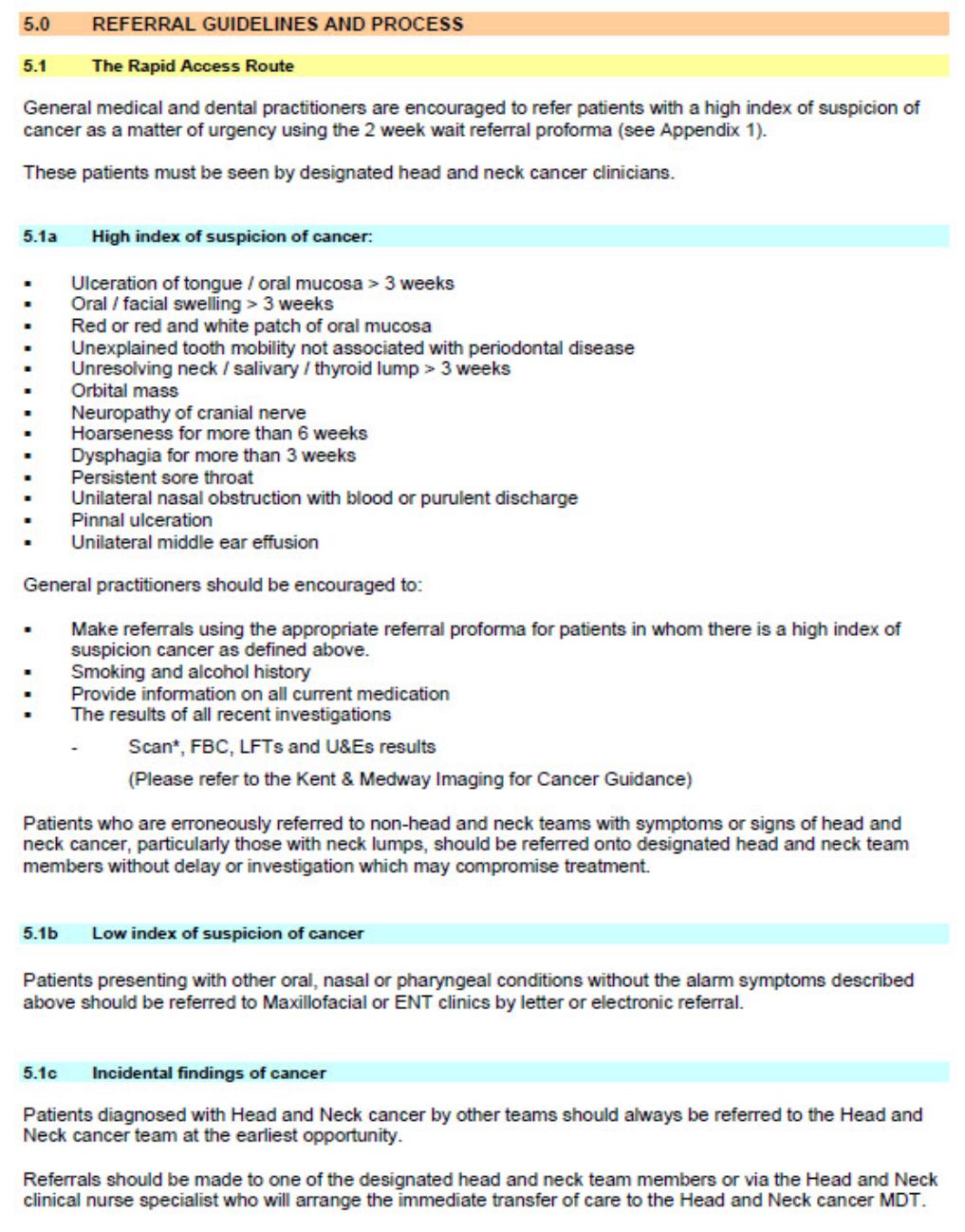
The Pathway of Care shows how a patient with a (District General Hospital) and seen within 2 weeks (in the UK).

If the lesion is thought to be suspicious, then investigations, imaging ± biopsy are carried out.

The biopsy results are ‘fast-tracked’ and the patient would be seen with the histological results of the biopsy, investigations & imaging results at the MDT (Multi-Disciplinary Team) meeting (held in my area, down at Maidstone Hospital, Kent).

Oral Cancer – Rapid Referral
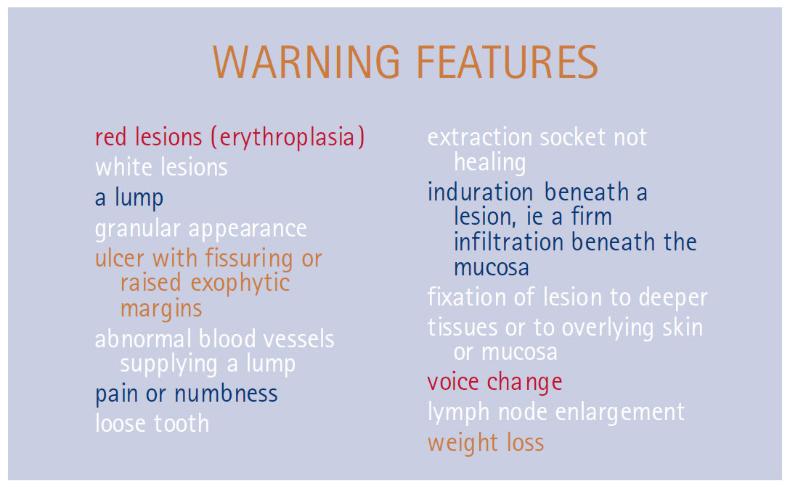
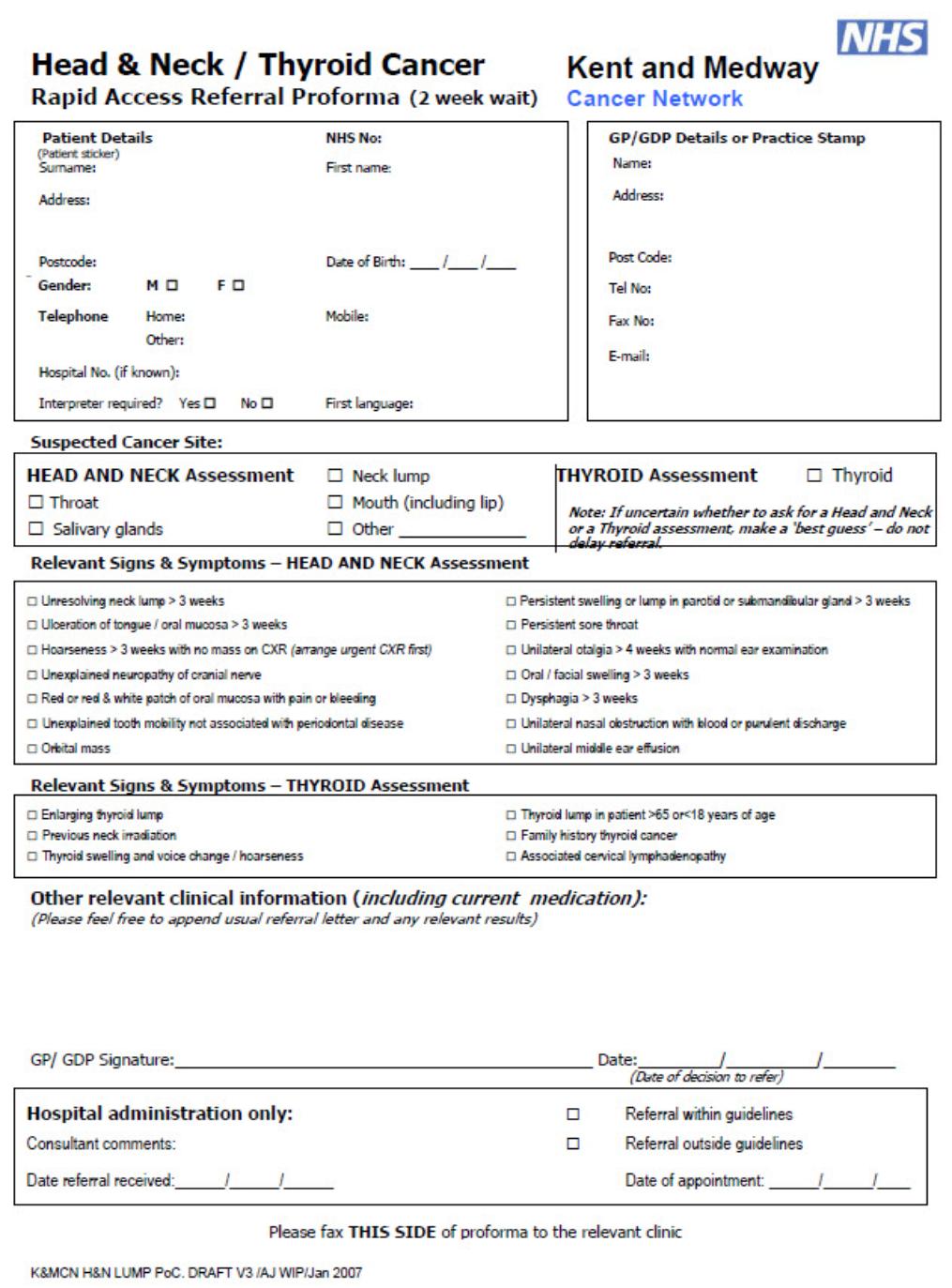
The suspicious features that the GDP should be aware of are listed here (high-lighted in yellow); these are in a box on the Rapid Referral Form.
The Pathway of Care shows how a patient with a (District General Hospital) and seen within 2 weeks (in the UK). If the lesion is thought to be suspicious, then investigations, imaging ± biopsy are carried out. The biopsy results are 'fast-tracked' and the patient would be seen with the histological results of the biopsy, investigations & imaging results at the MDT (Multi-Disciplinary Team) meeting (held in my area, down at Maidstone Hospital, Kent). The suspicious features that the GDP should be aware of are listed here (high-lighted in yellow); these are in a box on the Rapid Referral Form.
The Pathway of Care shows how a patient with a (District General Hospital) and seen within 2 weeks (in the UK). If the lesion is thought to be suspicious, then investigations, imaging ± biopsy are carried out. The biopsy results are ‘fast-tracked’ and the patient would be seen with the histological results of the biopsy, investigations & imaging results at the MDT (Multi-Disciplinary Team) meeting (held in my area, down at Maidstone Hospital, Kent). The suspicious features that the GDP should be aware of are listed here (high-lighted in yellow); these are in a box on the Rapid Referral Form.
The Pathway of Care shows how a patient with a (District General Hospital) and seen within 2 weeks (in the UK). If the lesion is thought to be suspicious, then investigations, imaging ± biopsy are carried out. The biopsy results are 'fast-tracked' and the patient would be seen with the histological results of the biopsy, investigations & imaging results at the MDT (Multi-Disciplinary Team) meeting (held in my area, down at Maidstone Hospital, Kent). The suspicious features that the GDP should be aware of are listed here (high-lighted in yellow); these are in a box on the Rapid Referral Form.
The Pathway of Care shows how a patient with a (District General Hospital) and seen within 2 weeks (in the UK). If the lesion is thought to be suspicious, then investigations, imaging ± biopsy are carried out. The biopsy results are ‘fast-tracked’ and the patient would be seen with the histological results of the biopsy, investigations & imaging results at the MDT (Multi-Disciplinary Team) meeting (held in my area, down at Maidstone Hospital, Kent). The suspicious features that the GDP should be aware of are listed here (high-lighted in yellow); these are in a box on the Rapid Referral Form.

These are the referral forms for suspected neoplastic / mitotic lesions – these are filled out & sent electronically

When consulting with your patient it is important that you record clinical status, signs, symptoms, referral process & what information & advice you gave the patient both verbally & in writing.

Records should be kept In-line with authoritative and professional guidance.

A “best practice” Head & Neck referral
Oral Cancer – Rapid Referral

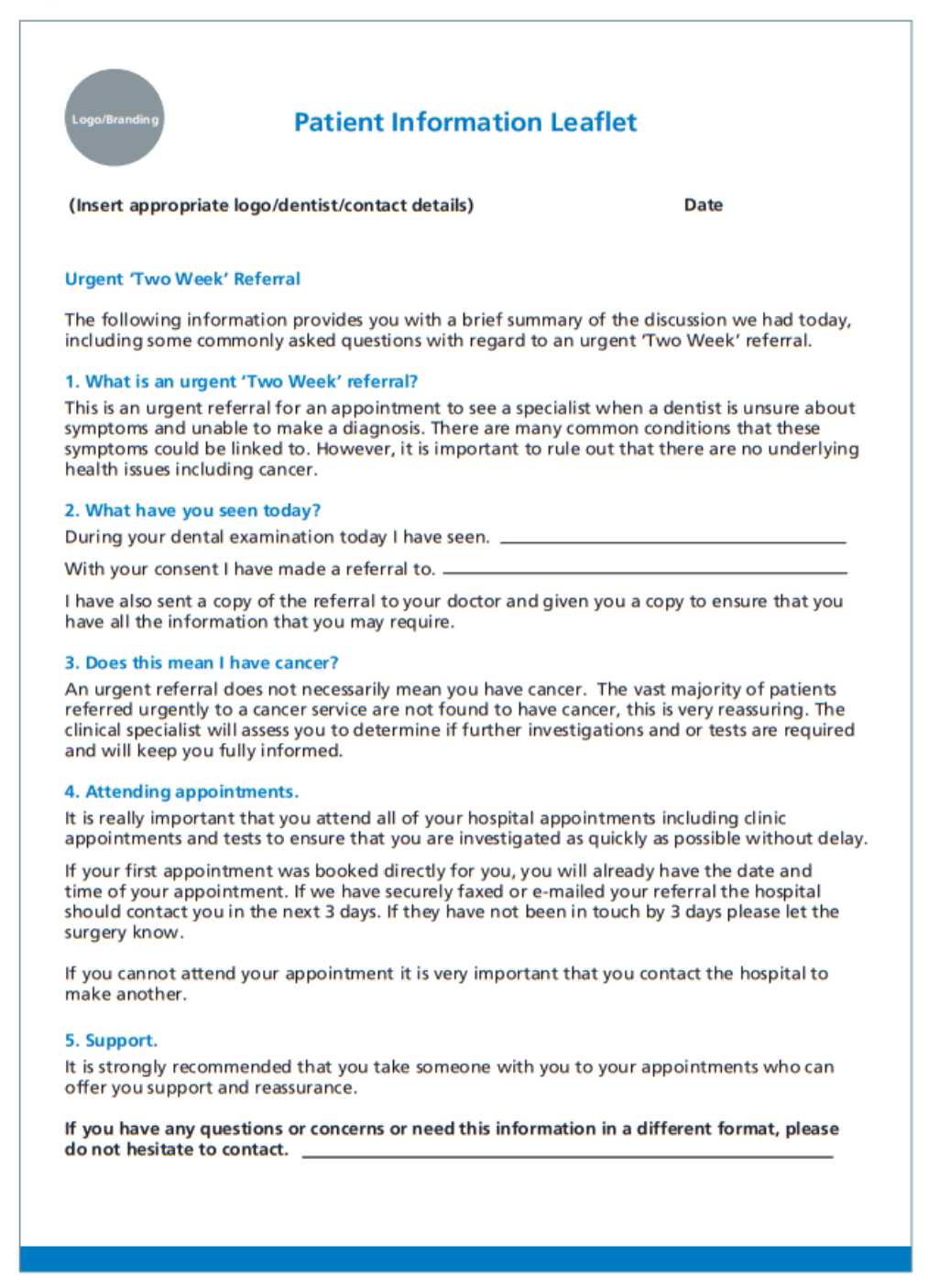
Information given to a patient should cover:

  • What an urgent ‘Two Week’ referral is
  • Why the patient is being referred to a 2nd care cancer service
  • The percentage of urgent ‘Two Week’ referrals that are cancerous
  • Which 2nd care cancer service the patient is being referred to
  • How they will receive their appointment
  • The importance of attendance
  • Whether the patient can take someone with them
  • What type of tests / investigations that might be carried out & how long it will take to get results & a diagnosis
  • How to obtain further help & information about the type of oral cancer suspected
Oral Cancer – Rapid Referral

Useful Articles & Websites

Cancer Research UK

Oral Cancer LDV

Clinical Knowledge Summaries

National Institute of Clinical Excellence

MacMillan Cancer Support

NICE Guidelines 2004. Healthcare Services for Head & Neck Cancers. Understanding NICE Guidance – Information for the Public

J Can Dent Assoc 2008. Biopsy & Histopathologic Diagnosis of Oral Premalignant & Malignant Lesions

BDJ 2010. Study of the Experience of Primary Care GDP’s in the detection & Management of Potentially Malignant Lesion. 1. Factors influencing detetction & the Decision to Refer

BDJ 2010. Study of the Experience of Primary Care GDP’s in the detection & Management of Potentially Malignant Lesion. 2. Mechanics of the Referral & Patient Communication

Dental Update 2011. Importance of Quality in Referral Letters Sent for Potentially Malignant Oral, Head & Neck Lesions

Head & Neck Cancer Guidelines 2011

BDJ 2015. Why Don’t Dentists Talk To Patients About Oral Cancer?

Dent Update 2016. Mouth Cancer for Clinicians Part 8. Referral

NICE Guidelines 2017. Head & Neck Cancer

BDJ 2018. Mouth Cancer – Presentation, Detection & Referral in Primary Dental Care

Dental Update 2020. Mouth Cancer – the Maxillofacial Surgeon’s perspective

Dental Update 2020. Mouth Cancer – What is it to Me & You

  • Cookie Policy
  • Privacy Policy
  • Terms & Conditions
  • Disclaimer
  • Adverts & Sponsors Policy
  • Contact Details

Copyright @ Exodontia - All things Oral Surgery 2026

Website by Hotgrafix

✕
  • Home
  • What is Oral Surgery?
  • Dental Nerve Injuries
  • Wisdom Teeth
    • Wisdom Teeth Removal Guidelines
    • Wisdom Teeth Treatment Options
    • Impaction Classification
    • Indices of Difficulty
  • Oral Surgical Procedures
    • Tooth Removal Warnings
    • What is a Biopsy?
    • Biopsy Warnings
    • Pericoronitis
    • Operculectomy
    • Coronectomy
    • Fraena & Tongue Ties
    • Ectopic & Extra Teeth
    • Exposing & Bonding of Brackets to Teeth
    • Apicectomy Explanation
    • Apicectomy & Retrograde Root Filling (RRF) Warnings
    • Cryotherapy
    • Fractured Maxillary Tuberosity
    • Maxillary Tuberosity Reduction
    • Mouth-Sinus Holes (Oro-Antral Communications)
    • Closure of Mouth-Sinus Holes
    • Buccal Flaps
    • Palatal Flaps
    • Buccal Fat Pad Repair
    • Alveoplasty
    • Removal of Tori
    • Caldwell-Luc / Intra-Oral Antrostomy
  • Post-op Instructions
    • Oro-Antral Regime
    • Post-Op Extraction Instructions
    • Post-op Biopsy Instructions
    • Post-Op Pain Control
  • Bleeding Problems
    • Bleeding Sockets
    • Coagulopathy Post-op Advice
  • Lumps, Bumps & ‘Patches’
    • Drugs for Oral Conditions
    • Amalgam Tattoo
    • Geographic Tongue
    • Black Hairy Tongue
    • Epulides
    • FEP’s & Oral Fibromata
    • Peripheral Ossifying Fibroma
    • Squamous Papilloma
    • Oral Frictional Hyperkeratosis (FK)
    • Oral Mucocœles
    • Oral Candidiasis
    • Denture Stomatitis
    • Median Rhomboid Glossitis
    • Angular Cheilitis
    • Papillary Hyperplasia of the Palate
    • Candidal Leukoplakia
    • Apical Granuloma
    • Parulis
    • Peri-Apical Cysts
    • Dentigerous Cyst
    • Odontogenic Keratocyst (OKC)
    • Solitary Bone Cyst
    • Aneurysmal Bone Cyst
    • Smoker’s Keratosis
    • Oral Aphthous Ulceration
    • Desquamative Gingivitis
    • Plasma Cell Gingivitis
    • Oral Lichen Planus
    • Pemphigus
    • Bullous Pemphigoid
    • Cicatricial Pemphigoid
    • Linear IgA Disease
    • Chronic Ulcerative Stomatitis
    • Drug-Induced Gingival Hyperplasia
    • Necrotising Sialometaplasia
    • Odontomes
    • Exostoses & Tori
    • Dense Bone Islands
    • Oral Blood Blisters
    • Oral & Lingual Tonsils
    • Pre-Malignant Lesions
    • Actinic Cheilitis
    • Oral Sub-Mucous Fibrosis
    • Oral Leukoplakia
    • Oral Cancer
      • Oral Cancer – Ætiological Factors
      • Oral Cancer – Oral Examination
      • Oral Cancer – Oral Screening
      • Oral Cancer – Rapid Referral
      • Oral Cancer – Role of GDP
    • Erythroplakia / Erythroplasia
    • Oral Mucositis
  • Dental Implants
    • Going Abroad for Dental Implants
    • Dental Implant Warnings
  • Oro-Facial Infections
    • Dry Socket
    • Osteomyeltis
    • Cervico-Fascial Infection
  • Mouth & Face Pains
    • Acupuncture
    • Atypical Odontalgia
    • Atypical Facial Pain
    • Burning Mouth Syndrome
    • Trigeminal Neuralgia
    • Post-Herpetic Neuralgia
    • Cranial / Temporal Arteritis
    • Trigeminal Sensory Neuropathy
    • Numb Chin Syndrome
    • Eagle Syndrome
    • Zinc Deficiency
  • Jaw Joint Problems
    • TMJ Arthrocentesis
    • Jaw Dislocation
    • Remedial Jaw Exercises
    • Clicking TMJ Exercises
    • Illustrated TMJ Exercises
    • Self-Care for TMJ Pain
    • Temporalis Tendonitis
    • Tooth Grinding
  • Surgical Dermatology
    • Scars & Their Treatment
    • Steroid Injections Into Scars
    • Seborrhœic Keratosis
    • 5-Fluorouracil, 5-FU, Efudix
    • Post-Op Instructions
  • Bleeding Diatheses & Oral Surgery
    • Coagulopathies & Oral Surgery
    • Warfarin & Oral Surgery
    • Anti-Thrombotics & Oral Surgery
    • NOAC’s & Oral Surgery
    • Platelet Disorders & Deficiencies
    • Hæmophilia & Oral Surgery
    • Rare Clotting Factor Deficiencies
    • Hæmatological Disorders
    • Dialysis & Oral Surgery
  • Salivary Gland Disorders
    • Dry Mouth & Xerostomia
    • Sjögren’s Syndrome
    • Minor Salivary Gland Biopsy (for Sjögren’s Syndrome Diagnosis)
    • Parotid Gland Removal / Superficial Parotidectomy
    • Submandibular Gland Removal
    • Sublingual Gland Removal
    • Ranulas / Ranulæ & Their Treatment
    • Sialosis / Sialadenosis
    • Frey’s Syndrome / Gustatory Sweating
    • Salivary Stone Release
    • Taste Disturbances
  • Dental & Facial Trauma
    • Dental Emergencies & Trauma
    • Facial Trauma
    • Fractures of the Mandible / Lower Jaw
    • Fractures of the Cheek Bone / Zygomatic Complex
    • Archbars & Buttons Removal
  • Oral Surgery & Pregnancy
  • Local Anaesthetic Allergy & Testing
  • Find A Dentist
  • Find An Endodontist
  • Membership & Links
  • Bibliography
  • Biography