
Exodontia.info
Menu
Exodontia.info
✕
info@exodontia.info

Median Rhomboid Glossitis

Median Rhomboid Glossitis (MRG), also known as Central Papillary Atrophy, Posterior Lingual Papillary Atrophy or Posterior Midline Atrophic Candidiasis, is a type of erythematous candidiasis unique to the midline posterior tongue. It occurs in as many as 1% of adults.

This affects the tongue. There is a central area on the tongue dorsum (just in front of the sulcus terminalis, approx 2/3’s of the way back on the tongue) that has no papillæ (depapillated). This is rhomboid in shape.
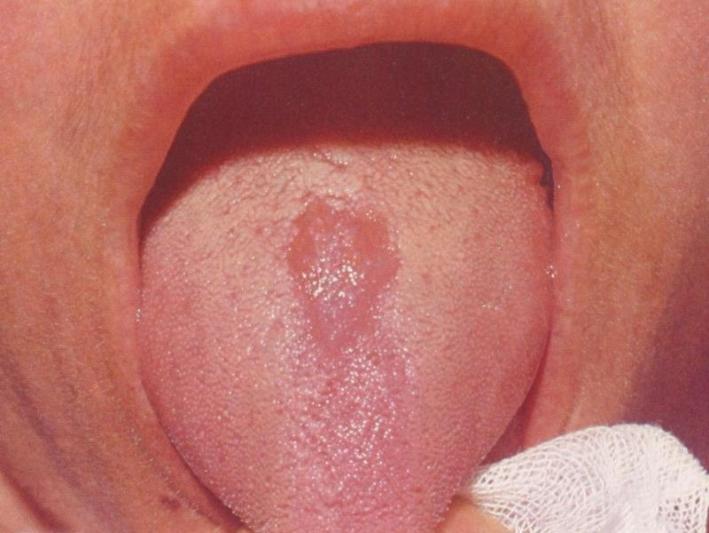
Median Rhomboid Glossitis

What are the causes of Median Rhomboid Glossitis (MRG)?

MRG was once thought to be a developmental defect that occurred during embryogenesis, caused by the failure of the tuberculum impar to be covered completely by the lateral processes of the tongue.

MRG is found anterior to the circumvallate papillæ. Since MRG is not found in children, a developmental ætiology has been largely discounted; however, a direct cause has not been established.

How is it diagnosed?

Prior to biopsy, the clinician should be certain that the midline lesion does not represent a lingual thyroid as it may be the only thyroid tissue present in the patient’s body. Additional clinical look-alike lesions include the gumma of tertiary syphilis, the granuloma of tuberculosis, deep fungal infections and granular cell tumour.

How is it treated?

No treatment is necessary for MRG but nodular cases are often removed for microscopic evaluation.

Anti-fungal therapy (topical troches or systemic medication) will reduce clinical erythema and inflammation due to candida infection. This therapy should ideally be given prior to the biopsy, in order to reduce the candida-induced pseudo-epitheliomatous hyperplasia features.

Some lesions will disappear entirely with anti-fungal therapy.

If the patient is a denture wearer, as with the treatment of any type of candida, the appliances, dentures or any other oral devices should be treated with anti-fungal agents.

Differential diagnosis: Candida infection, chemical burns, syphilis patches depending upon the clinical appearance, geographic tongue, nutritional deficiencies, lichen planus and traumatic ulcerations would be considerations. With any unexplained lesion, oral cancer is always considered, although the centre of the tongue is not a common area for malignancy.

Median Rhomboid Glossitis

Useful Articles & Websites

Registered Dental Hygienist Magazine

Wikipedia

American Association of Oral Medicine

American Academy of Oral Medicine 2007. Patient Information Sheet. Median Rhomboid Glossitis

ENT Journal 2007. Median Rhomboid Glossitis

New Engl J Med 2010. Images in Clinical Medicine. A Smooth Patch on the Tongue

Winter 2010. Pathology Snapshot. Median Rhomboid Glossitis

Iran Red Crescent Med J 2011. The Prevalence of Median Rhomboid Glossitis in Diabetic Patients. A Case-Control Study

2014. Median rhomboid glossitis with palatal ‘kissing lesion’. A Case Report

Int J Pharm & Bio Sci 2016. Median Rhomboid Glossitis. A Peculiar Tongue Pathology, Report of a Case & Review of Literature

Indian J Case Reports 2018. Atypical Median Rhomboid Glossitis. A Case Report

  • Cookie Policy
  • Privacy Policy
  • Terms & Conditions
  • Disclaimer
  • Adverts & Sponsors Policy
  • Contact Details

Copyright @ Exodontia - All things Oral Surgery 2026

Website by Hotgrafix

✕
  • Home
  • What is Oral Surgery?
  • Dental Nerve Injuries
  • Wisdom Teeth
    • Wisdom Teeth Removal Guidelines
    • Wisdom Teeth Treatment Options
    • Impaction Classification
    • Indices of Difficulty
  • Oral Surgical Procedures
    • Tooth Removal Warnings
    • What is a Biopsy?
    • Biopsy Warnings
    • Pericoronitis
    • Operculectomy
    • Coronectomy
    • Fraena & Tongue Ties
    • Ectopic & Extra Teeth
    • Exposing & Bonding of Brackets to Teeth
    • Apicectomy Explanation
    • Apicectomy & Retrograde Root Filling (RRF) Warnings
    • Cryotherapy
    • Fractured Maxillary Tuberosity
    • Maxillary Tuberosity Reduction
    • Mouth-Sinus Holes (Oro-Antral Communications)
    • Closure of Mouth-Sinus Holes
    • Buccal Flaps
    • Palatal Flaps
    • Buccal Fat Pad Repair
    • Alveoplasty
    • Removal of Tori
    • Caldwell-Luc / Intra-Oral Antrostomy
  • Post-op Instructions
    • Oro-Antral Regime
    • Post-Op Extraction Instructions
    • Post-op Biopsy Instructions
    • Post-Op Pain Control
  • Bleeding Problems
    • Bleeding Sockets
    • Coagulopathy Post-op Advice
  • Lumps, Bumps & ‘Patches’
    • Drugs for Oral Conditions
    • Amalgam Tattoo
    • Geographic Tongue
    • Black Hairy Tongue
    • Epulides
    • FEP’s & Oral Fibromata
    • Peripheral Ossifying Fibroma
    • Squamous Papilloma
    • Oral Frictional Hyperkeratosis (FK)
    • Oral Mucocœles
    • Oral Candidiasis
    • Denture Stomatitis
    • Median Rhomboid Glossitis
    • Angular Cheilitis
    • Papillary Hyperplasia of the Palate
    • Candidal Leukoplakia
    • Apical Granuloma
    • Parulis
    • Peri-Apical Cysts
    • Dentigerous Cyst
    • Odontogenic Keratocyst (OKC)
    • Solitary Bone Cyst
    • Aneurysmal Bone Cyst
    • Smoker’s Keratosis
    • Oral Aphthous Ulceration
    • Desquamative Gingivitis
    • Plasma Cell Gingivitis
    • Oral Lichen Planus
    • Pemphigus
    • Bullous Pemphigoid
    • Cicatricial Pemphigoid
    • Linear IgA Disease
    • Chronic Ulcerative Stomatitis
    • Drug-Induced Gingival Hyperplasia
    • Necrotising Sialometaplasia
    • Odontomes
    • Exostoses & Tori
    • Dense Bone Islands
    • Oral Blood Blisters
    • Oral & Lingual Tonsils
    • Pre-Malignant Lesions
    • Actinic Cheilitis
    • Oral Sub-Mucous Fibrosis
    • Oral Leukoplakia
    • Oral Cancer
      • Oral Cancer – Ætiological Factors
      • Oral Cancer – Oral Examination
      • Oral Cancer – Oral Screening
      • Oral Cancer – Rapid Referral
      • Oral Cancer – Role of GDP
    • Erythroplakia / Erythroplasia
    • Oral Mucositis
  • Dental Implants
    • Going Abroad for Dental Implants
    • Dental Implant Warnings
  • Oro-Facial Infections
    • Dry Socket
    • Osteomyeltis
    • Cervico-Fascial Infection
  • Mouth & Face Pains
    • Acupuncture
    • Atypical Odontalgia
    • Atypical Facial Pain
    • Burning Mouth Syndrome
    • Trigeminal Neuralgia
    • Post-Herpetic Neuralgia
    • Cranial / Temporal Arteritis
    • Trigeminal Sensory Neuropathy
    • Numb Chin Syndrome
    • Eagle Syndrome
    • Zinc Deficiency
  • Jaw Joint Problems
    • TMJ Arthrocentesis
    • Jaw Dislocation
    • Remedial Jaw Exercises
    • Clicking TMJ Exercises
    • Illustrated TMJ Exercises
    • Self-Care for TMJ Pain
    • Temporalis Tendonitis
    • Tooth Grinding
  • Surgical Dermatology
    • Scars & Their Treatment
    • Steroid Injections Into Scars
    • Seborrhœic Keratosis
    • 5-Fluorouracil, 5-FU, Efudix
    • Post-Op Instructions
  • Bleeding Diatheses & Oral Surgery
    • Coagulopathies & Oral Surgery
    • Warfarin & Oral Surgery
    • Anti-Thrombotics & Oral Surgery
    • NOAC’s & Oral Surgery
    • Platelet Disorders & Deficiencies
    • Hæmophilia & Oral Surgery
    • Rare Clotting Factor Deficiencies
    • Hæmatological Disorders
    • Dialysis & Oral Surgery
  • Salivary Gland Disorders
    • Dry Mouth & Xerostomia
    • Sjögren’s Syndrome
    • Minor Salivary Gland Biopsy (for Sjögren’s Syndrome Diagnosis)
    • Parotid Gland Removal / Superficial Parotidectomy
    • Submandibular Gland Removal
    • Sublingual Gland Removal
    • Ranulas / Ranulæ & Their Treatment
    • Sialosis / Sialadenosis
    • Frey’s Syndrome / Gustatory Sweating
    • Salivary Stone Release
    • Taste Disturbances
  • Dental & Facial Trauma
    • Dental Emergencies & Trauma
    • Facial Trauma
    • Fractures of the Mandible / Lower Jaw
    • Fractures of the Cheek Bone / Zygomatic Complex
    • Archbars & Buttons Removal
  • Oral Surgery & Pregnancy
  • Local Anaesthetic Allergy & Testing
  • Find A Dentist
  • Find An Endodontist
  • Membership & Links
  • Bibliography
  • Biography