
Solitary Bone Cyst
(Traumatic Bone Cyst, Unicameral Bone Cyst, Progressive Bone Cavity, Extravasation Cyst, Hæmorrhagic Bone Cyst, Unilateral Bone Cyst & Progressive Bone Cavity)
Simple Bone Cysts (SBC’s) are benign cysts that develop in children in their first two decades. Whilst normally found in the within the medulla of long bones, 10% occur in the jaws; 75% of these being in the body of the mandible (lower jaw).
SBC’s are predominantly seen in the mandible, more frequently involving the posterior region and less common in the anterior mandible (front of the lower jaw) / mandibular symphysis (midline lower jaw). They are more frequently seen during the 2nd decade of life and sex distribution is quite even.
The cyst is known by several other names, including Traumatic Bone Cyst, Unicameral Bone Cyst, Progressive Bone Cavity, Extravasation Cyst, Hæmorrhagic Bone Cyst, Unilateral Bone Cyst & Progressive Bone Cavity.
It is relatively uncommon with a reported incidence of 0.6% (from a study of 3353 bone cysts) and tends to occur more frequently in males, presenting in the second and third decades.

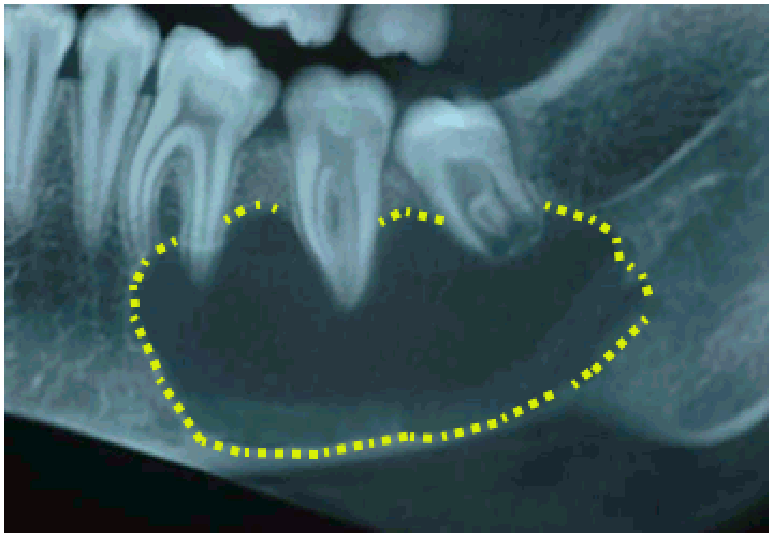
What are Solitary Bone Cysts (SBC’s)?
Simple Bone Cysts (SBC’s) are benign cysts that develop in children in their first two decades. Whilst normally found in the “long” bones, 10% occur in the jaws. The vast majority of these are in the mandible (lower jaw). They are more frequently seen during the 2nd decade of life and sex distribution is quite even.
What are the signs & symptoms?
Lesions are generally asymptomatic, however, a few authors have reported symptoms including pain, tooth sensitivity, paræsthesia and delayed displacement of the Inferior Dental Canal.
SBC’s are predominantly seen in the mandible, more frequently involving the posterior region and less common in the anterior mandible.

What are the causes of Solitary Bone Cysts (SBC’s)?
It has been speculated that SBC’s arise as a result of occlusal trauma, causing intra-medullary bleeding and aberrant healing with cavity formation (liquefactive necrosis or resorption of blood clot following intra-medullary hæmorrhage due to trauma results in the destruction of the surrounding bone by enzymatic activity, thereby causing enlargement of the bone cavity).
This theory explains why traumatic bone cysts occur more often in young individuals (an age at which trauma occurs more often) and also explain the presence of blood within the cavity at the time of surgical exploration. Reports of trauma at the site of lesions and the presence of blood in the cavities, however, are uncommon.
The content of the cavity depends on the length of the time that the cyst has existed. In the early stages, the cyst usually contains blood or sero-sanguineous fluid that lessens with the age of the lesion and eventually becomes empty. Since material for histological examination may be scant or non-existent, it is very often difficult for a definite histological diagnosis to be achieved. Indeed, the diagnosis of SBC can be established only after surgical exploration of the bone cavity.
Other theories include:
cystic degeneration of fibro-osseous lesions / existing bone tumour
intra-osseous vascular anomalies (loss of blood supply to a hæmangioma / lymphoma)
alteration of bony metabolism (faulty calcium metabolism as a result of systemic disease such as para-thyroid diseases)
low-grade infection
infection of bone marrow
ischaemic necrosis of the fatty bone marrow
changes and reduction in the osteo-genic activity
imbalance between the osteo-clastic & osteo-blastic activity due to trauma
failure of mesenchymal tissue to form bone & cartilage & instead becomes immature as multiple bursa-like synovial cavities
developmental defect
How are they diagnosed?
On radiological examination, between 61 – 79% of SBC’s are radio-lucent. However, 21% have radio-opaque foci & 7% may show “cloudiness”.
The border of the SBC, although irregular, can vary from well-defined to a complete absence of cortical outline.
It is usually detected incidentally during routine radiographic examination, which can be attributed to the asymptomatic nature of the lesion. Radiographically, SBC’s usually appears as an uni-locular radiolucent area with an irregular, well-defined / partly well-defined outline and with / without a sclerotic lining around the periphery of the lesion.
Projection of the lesion into the inter-radicular bone spaces produces a scalloping effect around the roots of the associated teeth. Scalloping / inter-digitation between the roots of teeth was a common feature in 44 – 68% of the cases.
Root resorption is rather uncommon and the surrounding teeth are vital. The bone cavity may either be empty or present a thin connective tissue layer with a scant liquid content.
Loss of lamina dura is predominantly in patients over 30 years of age and there is minimal involvement in younger people.
Displacement of teeth and root resorption are rare although in one series they were reported in 9 and 22% of the cases, respectively.
The definite diagnosis of SBC is invariably achieved at surgery when an empty bone cavity without epithelial lining is observed, leaving very little except normal bone and occasional fibrous tissue curetted from the cavity wall for the histo-pathologist.
Sometimes, the cavity contains a straw-colored fluid / bright blood. Most of the histologic findings reveal fibrous connective tissue and normal bone. There is never any evidence of an epithelial lining. The lesion may exhibit areas of vascularity, fibrin, erythrocytes and occasional giant cells adjacent to the bone surface
How are they treated?
The widely recommended treatment for SBC is surgical exploration followed by curettage of the bony walls. The surgical exploration serves as both a diagnostic manoeuvre and as definitive therapy by producing bleeding in the cavity.
Resolution usually takes about 6 months or longer, depending on the size of the lesion. The prognosis is usually good and recurrence is rare.
Other alternative treatments include use of allogenic materials like lyophilised bone, hydroxyl-apatite or gel foam to fill the bone cavity in cases where conventional management fails and dental implant rehabilitation is required.
Differential Diagnosis:
- Keratocystic Odontogenic Tumour
- Hæmophillic Intra-Osseous Pseudo-Tumour
- Enchondroma
- Osteoblastoma
- Spina ventosa
- Ameloblastoma
- Central Giant Cell Granuloma
- Chondromyxoid Fibroma
- Desmoplasmic Fibroma
- Aneurysmal Bone Cyst
- Monostotic Fibrous Dysplasia
- Non-Ossifying Fibroma
- Eosinophilic Granuloma
- Brown Tumour
Useful Articles & Websites
J Ind Acad Oral Med Radiol 2010. Solitary Bone Cyst. A Case Report & Review of the Literature
J Pharmaceut Biomed Sci 2011. Solitary Bone Cyst of Mandible
Ann Maxillofac Surg 2016. Simple Bone Cyst of the Mandibular Condyle
J IMAB. 2020. Case Report. Traumatic Bone Cyst of the Mandible