
Apicectomy / Surgical Endodontics – What Is It?
An apicectomy is a surgical procedure in which the root-tip of a tooth is removed and the truncated root-tip is hermetically sealed with a root-filling.
An apicectomy (also known as surgical endodontics, apical surgery or peri-radicular surgery) should be considered only when conventional endodontic root filling (‘root canal treatment’) techniques have failed.
A conventional endodontic treatment is indicated if the dental pulp (‘nerve’) of a tooth becomes non-vital (dies) or is likely to be put at risk due to the type or size of restoration needed to repair the tooth.
During endodontic treatment, the dentist removes the dead remnants of the dental pulp and replaces it with an inert filling material which is visible on an X-ray.
As there is good evidence that endodontic re-treatment has higher success rates than apical surgery, patients are advised to pursue a non-surgical treatment if root canal treatment is initially unsuccessful (www.aae.org/patients/patientinfo/faqs/retxsum.htm and www.britishendodonticsociety.org.uk/patient_information.html).
Most teeth will respond satisfactorily to this type of treatment and become symptom-free.
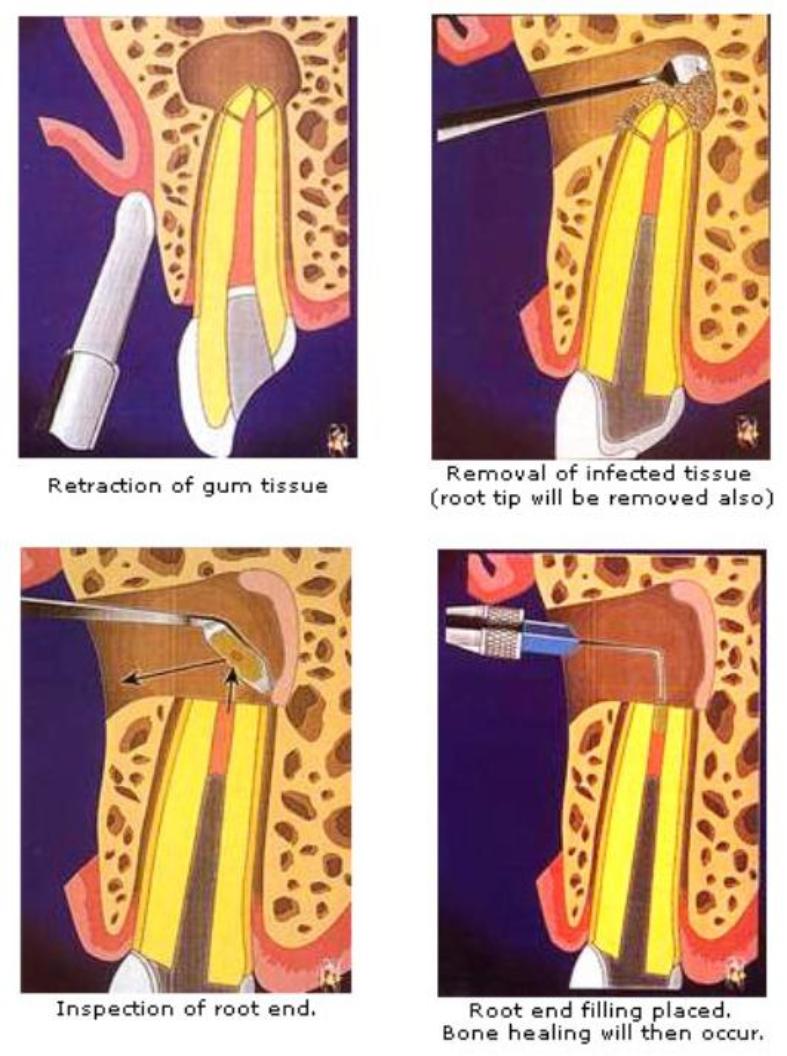
The 2 main indications for apical surgery are:
1. Obtain a biopsy (where the tooth-tip pathology is greater than 1cm in diameter)
2. To achieve what could not be done by endodontic re-treatment such as:
- The recovery of broken / retained of root-canal / endodontic instruments
- Where the root canal is in-filled / blocked / obliterated
- The repair of root perforations
- Where the root is fractured
- Where there is good root canal treatment yet still root pathology
- Where the tooth is a crucial support for a bridge and the bridge support is in a reasonable condition (ie the bridge / tooth can readily be ‘saved’)
There is increased difficulty of the operation due to anatomical & dental anatomical considerations, such as:
- Mouth Anatomy. Small oral opening, a prominent chin, Inferior Alveolar & Mental Nerves, active facial & mouth muscles, bony prominences (such as the zygomatic process; anterior nasal spine, external oblique ridge) and a shallow ‘trough’ (vestibule) between the teeth, cheek and lips can hamper the operation.
- Jaw Bone Thickness. The jaw bone is thicker in the root tip region and more difficult access to the root end
Lower Incisors & Canines / Eye-Teeth (Upper & Lower), complicated by:
- Root Anatomy. Long and broad roots, that are in proximity to adjacent roots and tilted towards either the roof of the mouth (if upper) or the floor of the mouth (if lower) (making access for the procedure difficult and hence lower success rate for op).
Apicectomies ARE NOT done on:
- Teeth that have been previously apicected (low success rate for repeat apicectomies)
- Molar teeth (difficult access, low success rate and potential problems with nerves & sinuses)
- Patients who have poor oral hygiene, active gum disease or uncontrolled tooth decay
- Teeth where the post-crowns do not fit the root canal or the post has been re-cemented on more than 1 occasion
- Teeth where there is little tooth substance left to place a crown on afterwards
- Teeth which have post-crowns that can be removed to allow re-treatment
- Patients who require intravenous sedation / general anaesthesia
- Patients at risk from bacterial endocarditis or with blood clotting disorders
Upper Premolars / Bicuspids, complicated by:
- Multiple Roots are present that often diverge widely from each other (making access for the procedure difficult and hence lower success rate for op)
- Sinus Floor can often be in close proximity to the tooth tips that are being operated on. There is a chance of perforating into the sinus (10 – 50% of cases) and causing acute ± chronic sinusitis (especially if any debris has gone into the sinus).
- Root Anatomy is such that they are often difficult to get a good root canal filling (due to isthmus / anastomosis of the root systems). Hence, the chances of success of the apicectomy will be reduced.
Useful Articles & Websites
Chapter 12. Endodontic Surgery (2002)
Dental Update 2004. Root Canal Retreatment. 1. Case Assessment and Treatment Planning
Dental Update 2004. Root Canal Retreatment. 2. Practical Solutions
Endo Topics 2004. Classification, Diagnosis & Clinical Manifestations of Apical Periodontitis
Endodontology 2005. Newer Classification of Endodontic Flaps
Endo Topics 2005. Surgical Endodontics. Quo Vadis?
JOMS 2005. Failed Root Canals – The Case for Apicoectomy (Periradicular Surgery)
Dental Update 2006. Root Canal Retreatment
J Endo 2006. Modern Endodontic Surgery Concepts & Practice – A Review
Med Oral Patol Oral Cir Bucal 2006. An Update in Periapical Surgery
Chapter 6. Surgical Endodontics. IR Matthews (2007)
J Endod 2010. Prognostic Factors in Apical Surgery with Root-End Filling – A Meta-Analysis.
Evidence Based Dentistry 2011. Endodontic Surgery Prognostic Factors (J Endod 2010)
Roots 2011. Predictable Apical Microsurgery (Part 1)
Saudi Dent J 2011. Review Article. Apical Surgery. A Review of Current Techniques & Outcome
BDJ 2012. Update of Guidelines for Surgical Endodontics – the Position after 10 Years
BDJ 2013. Oral Surgery – Part 2. Endodontic Surgery
RSBO 2013. Apicoectomy after Conventional Endodontic Treatment Failure – Case Report
BDJ 2015. Pre- & Postoperative Management Techniques. Part 3. Before & After – Endodontic Surgery
Med Oral Patol Oral Cir Bucal. 2015. Prognostic Factors on Periapical Surgery – A Systematic Review
J Tissue Sci Eng 2016. Immunopathology of Apical Periodontitis & Refractory Cases
BDJ 2017. Letters to the Editor. Referrals. Apicectomy
Dental Update 2017. Surgical Endodontics to Manage a Separated Instrument – A Case Report
BDJ 2018. Surgical Endodontics. Are the Guidelines being Followed A Pilot Survey
Dental Update 2018. Surgical Root Perforation Repair with Guided Tissue Regeneration – A Case Report
BDJ 2019. Endodontic Microsurgery. Part 1. Diagnosis, Patient Selection & Prognoses
BDJ 2019. Endodontic Microsurgery. Part 2. Armamentarium & Technique