Exodontia.info
Menu
Exodontia.info
✕
info@exodontia.info

Desquamative Gingivitis

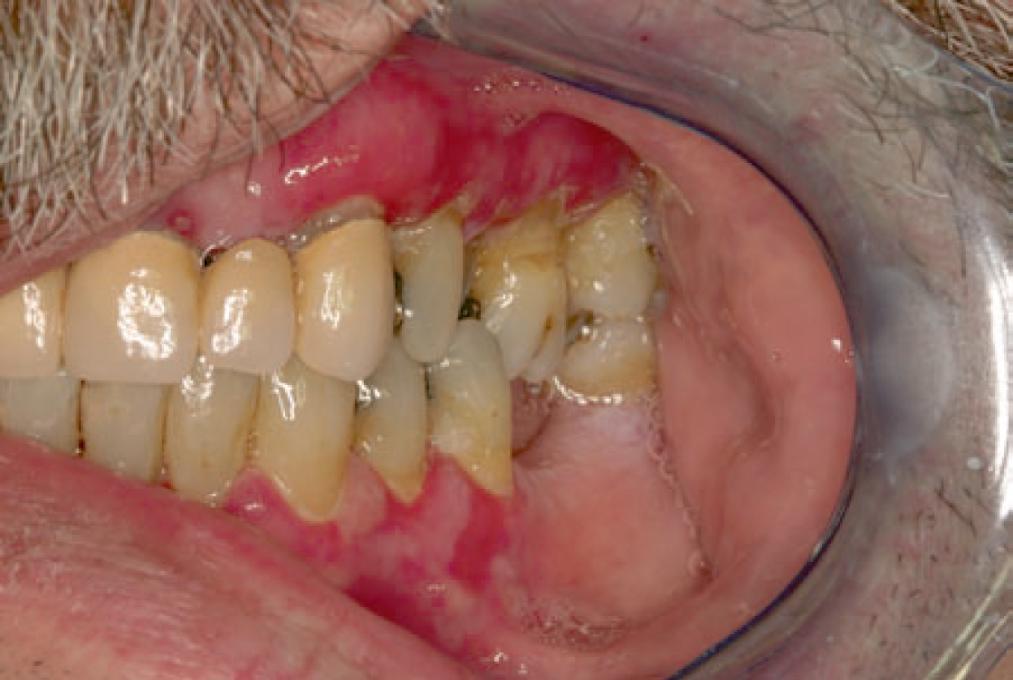
The term ‘desquamative gingivitis’ is a clinical description, not a diagnosis.

It is used for conditions in which the gingivæ (gums) appear red or raw. Usually the whole of the attached gingiva of varying numbers of teeth is affected.

This is a clinical descriptive term used for non-specific gingival (gum) manifestation of several chronic muco-

With rare exceptions, an auto-immune mechanism is responsible. Cicatricial Pemphigoid and Lichen Planus are the most common auto-immune diseases that manifest Desquamative Gingivitis.

Less commonly are Bullous Pemphigoid, Pemphigus, Linear IgA Disease, Epidermolysis Bullosa Acquisita (weblink), Chronic Ulcerative Stomatitis, Discoid Lupus Erythematosus and Psoriasis.

Desquamative Gingivitis has also been associated with:

  • Chemical damage, such as reactions to sodium lauryl sulphate in toothpastes.
  • Allergic responses.
  • Drugs.
  • Pyostomatitis vegetans.
Desquamative Gingivitis

attached gingiva (gum).

The ‘facial’ (that is, the surfaces facing out towards the lips and cheeks) surface is more frequently affected than the lingual / palatal gingivæ. Spontaneous desquamation of the epithelia, blister formation and areas of superficial erosions are common.

Some patients make no complaint, but the main complaint is of persistent soreness of the gingivæ; worse when eating acerbic or spicy foods such as tomatoes, citrus fruits and others.

The desquamation may vary from mild, almost insignificant small patches to widespread redness a ‘glazed’ appearance.

In addition to a full history and examination, biopsy examination and appropriate histo-pathological and immunological investigations are frequently indicated.

Some other conditions can present with redness or ulcers rather than the atrophy or erosions typical of Desquamative Gingivitis and should be excluded.

Such appearances may be seen in:

  • reactions to various mouthwashes, chewing gum, medications and
  • dental materials
  • candidiasis (Thrush)
  • lupus erythematosus
  • plasma cell gingivitis
  • Crohn’s disease, sarcoidosis and oro-facial granulomatosis
  • leukæmias
  • factitial (self-induced) lesions.

The treatment of desquamative gingivitis consists of:

  • improving the oral hygiene
  • minimising irritation of the lesions
  • specific therapies for the underlying disease where available
  • often local / systemic immuno-suppressive or dapsone therapy, notably cortico-steroids. Cortico-steroid creams used overnight in a soft polythene splint, may help.

Useful Articles & Websites

Dental Update 1999. Orofacial Disease – Update for the Dental Clinical Team 7. Complaints Affecting Particularly the Palate or Gingivae

Australian Dental Journal 2003. Desquamative Gingivitis. A Sign of Mucocutaneous Disorders

Journal of IMAB – Annual Proceeding (Scientific Papers) 2007. Desquamative Gingivitis as a Symptom of Different Mucocutaneous Disorders

Dental Update 2017. Desquamative Gingivitis − Aetiology, Diagnosis & Management

  • Cookie Policy
  • Privacy Policy
  • Terms & Conditions
  • Disclaimer
  • Adverts & Sponsors Policy
  • Contact Details

Copyright @ Exodontia - All things Oral Surgery 2026

Website by Hotgrafix

✕
  • Home
  • What is Oral Surgery?
  • Dental Nerve Injuries
  • Wisdom Teeth
    • Wisdom Teeth Removal Guidelines
    • Wisdom Teeth Treatment Options
    • Impaction Classification
    • Indices of Difficulty
  • Oral Surgical Procedures
    • Tooth Removal Warnings
    • What is a Biopsy?
    • Biopsy Warnings
    • Pericoronitis
    • Operculectomy
    • Coronectomy
    • Fraena & Tongue Ties
    • Ectopic & Extra Teeth
    • Exposing & Bonding of Brackets to Teeth
    • Apicectomy Explanation
    • Apicectomy & Retrograde Root Filling (RRF) Warnings
    • Cryotherapy
    • Fractured Maxillary Tuberosity
    • Maxillary Tuberosity Reduction
    • Mouth-Sinus Holes (Oro-Antral Communications)
    • Closure of Mouth-Sinus Holes
    • Buccal Flaps
    • Palatal Flaps
    • Buccal Fat Pad Repair
    • Alveoplasty
    • Removal of Tori
    • Caldwell-Luc / Intra-Oral Antrostomy
  • Post-op Instructions
    • Oro-Antral Regime
    • Post-Op Extraction Instructions
    • Post-op Biopsy Instructions
    • Post-Op Pain Control
  • Bleeding Problems
    • Bleeding Sockets
    • Coagulopathy Post-op Advice
  • Lumps, Bumps & ‘Patches’
    • Drugs for Oral Conditions
    • Amalgam Tattoo
    • Geographic Tongue
    • Black Hairy Tongue
    • Epulides
    • FEP’s & Oral Fibromata
    • Peripheral Ossifying Fibroma
    • Squamous Papilloma
    • Oral Frictional Hyperkeratosis (FK)
    • Oral Mucocœles
    • Oral Candidiasis
    • Denture Stomatitis
    • Median Rhomboid Glossitis
    • Angular Cheilitis
    • Papillary Hyperplasia of the Palate
    • Candidal Leukoplakia
    • Apical Granuloma
    • Parulis
    • Peri-Apical Cysts
    • Dentigerous Cyst
    • Odontogenic Keratocyst (OKC)
    • Solitary Bone Cyst
    • Aneurysmal Bone Cyst
    • Smoker’s Keratosis
    • Oral Aphthous Ulceration
    • Desquamative Gingivitis
    • Plasma Cell Gingivitis
    • Oral Lichen Planus
    • Pemphigus
    • Bullous Pemphigoid
    • Cicatricial Pemphigoid
    • Linear IgA Disease
    • Chronic Ulcerative Stomatitis
    • Drug-Induced Gingival Hyperplasia
    • Necrotising Sialometaplasia
    • Odontomes
    • Exostoses & Tori
    • Dense Bone Islands
    • Oral Blood Blisters
    • Oral & Lingual Tonsils
    • Pre-Malignant Lesions
    • Actinic Cheilitis
    • Oral Sub-Mucous Fibrosis
    • Oral Leukoplakia
    • Oral Cancer
      • Oral Cancer – Ætiological Factors
      • Oral Cancer – Oral Examination
      • Oral Cancer – Oral Screening
      • Oral Cancer – Rapid Referral
      • Oral Cancer – Role of GDP
    • Erythroplakia / Erythroplasia
    • Oral Mucositis
  • Dental Implants
    • Going Abroad for Dental Implants
    • Dental Implant Warnings
  • Oro-Facial Infections
    • Dry Socket
    • Osteomyeltis
    • Cervico-Fascial Infection
  • Mouth & Face Pains
    • Acupuncture
    • Atypical Odontalgia
    • Atypical Facial Pain
    • Burning Mouth Syndrome
    • Trigeminal Neuralgia
    • Post-Herpetic Neuralgia
    • Cranial / Temporal Arteritis
    • Trigeminal Sensory Neuropathy
    • Numb Chin Syndrome
    • Eagle Syndrome
    • Zinc Deficiency
  • Jaw Joint Problems
    • TMJ Arthrocentesis
    • Jaw Dislocation
    • Remedial Jaw Exercises
    • Clicking TMJ Exercises
    • Illustrated TMJ Exercises
    • Self-Care for TMJ Pain
    • Temporalis Tendonitis
    • Tooth Grinding
  • Surgical Dermatology
    • Scars & Their Treatment
    • Steroid Injections Into Scars
    • Seborrhœic Keratosis
    • 5-Fluorouracil, 5-FU, Efudix
    • Post-Op Instructions
  • Bleeding Diatheses & Oral Surgery
    • Coagulopathies & Oral Surgery
    • Warfarin & Oral Surgery
    • Anti-Thrombotics & Oral Surgery
    • NOAC’s & Oral Surgery
    • Platelet Disorders & Deficiencies
    • Hæmophilia & Oral Surgery
    • Rare Clotting Factor Deficiencies
    • Hæmatological Disorders
    • Dialysis & Oral Surgery
  • Salivary Gland Disorders
    • Dry Mouth & Xerostomia
    • Sjögren’s Syndrome
    • Minor Salivary Gland Biopsy (for Sjögren’s Syndrome Diagnosis)
    • Parotid Gland Removal / Superficial Parotidectomy
    • Submandibular Gland Removal
    • Sublingual Gland Removal
    • Ranulas / Ranulæ & Their Treatment
    • Sialosis / Sialadenosis
    • Frey’s Syndrome / Gustatory Sweating
    • Salivary Stone Release
    • Taste Disturbances
  • Dental & Facial Trauma
    • Dental Emergencies & Trauma
    • Facial Trauma
    • Fractures of the Mandible / Lower Jaw
    • Fractures of the Cheek Bone / Zygomatic Complex
    • Archbars & Buttons Removal
  • Oral Surgery & Pregnancy
  • Local Anaesthetic Allergy & Testing
  • Find A Dentist
  • Find An Endodontist
  • Membership & Links
  • Bibliography
  • Biography