
Drug-Induced Gingival Hyperplasia
Many terms have been used to describe gingival overgrowth (GO). The expression gingival hyperplasia (“abnormal increase in the number of normal cells in a normal arrangement in an organ or tissue, which increase in volume”) and gingival hypertrophy (“enlargement or overgrowth of an organ or part due to an increase in size of its constituent cells”) have been also used, although gingival overgrowth is the general term that better describes this iatrogenic condition.
The drugs mainly associated with GO are:
• Phenytoin, a drug used for the management of epilepsy, and other anti-convulsants such as sodium valproate, phenobarbital, vigabatrin.
• Ciclosporin, an immuno-suppressant drug used to reduce organ transplant rejection;
• Calcium-channel blockers (nifedipine, verapamil, diltiazem, oxodipine, amlodipine), a group of anti-hypertensive drugs.
Other drugs, such as antibiotics (erythromycin) and hormones, have been also associated with this side effect.
Not all patients using these drugs are affected by gingival overgrowth and the extent and severity of the overgrowth is variable in such patients.
The relationship between age and GO is uncertain.
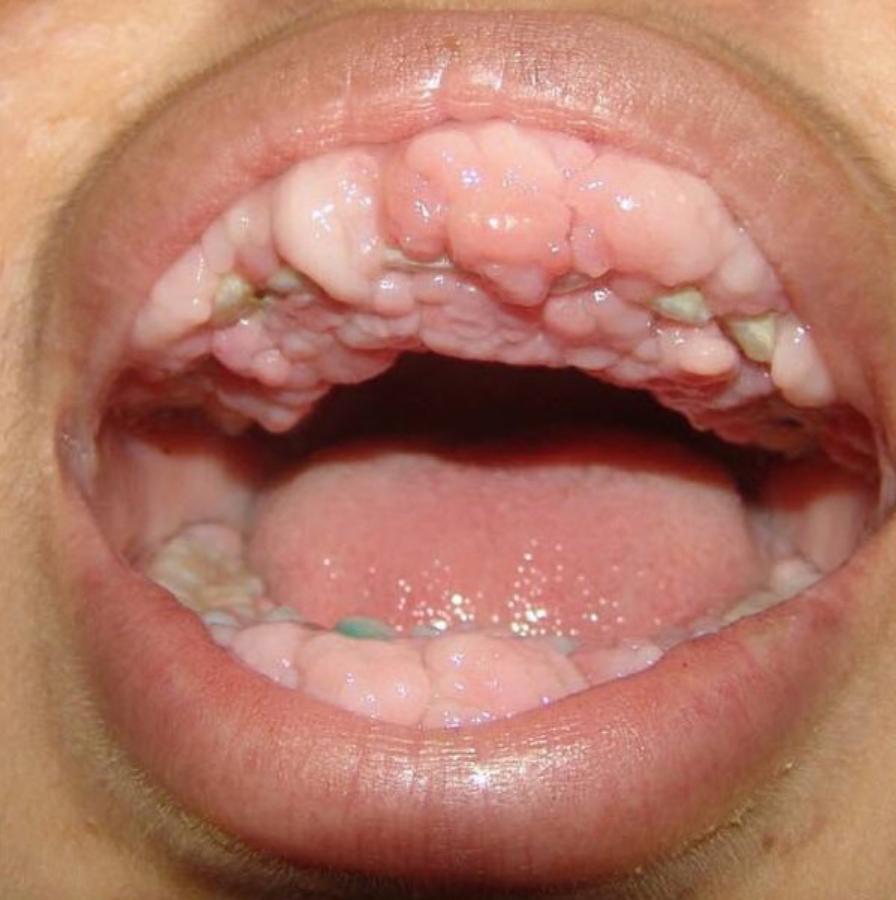

labially (lip-side). Papillæ (the triangular pieces of gum twixt teeth) are firm, pale and enlarge to form false, vertical clefts. This may be associated with hypertrichosis (hairyness). The GO is usually related to the dose of the drug, the duration of drug therapy, the serum concentration (the concentration of the drug in the blood stream) and the presence of dental plaque. Clinically, both marginal gingiva and inter-dental papillæ appear enlarged and firm with a surface that may be smooth, stippled, or lobulated with little or no inflammation.
The GO may be localised or generalised and can partially or entirely cover the crown of the teeth. In severe cases, difficulties in mastication (chewing) and speech may occur. The diagnosis is made on the basis of the medical history and the clinical features.
What are the causes of Drug-Induced Gingival Overgrowth?
Some of the risk factors known to contribute to GO include the presence of gingival inflammation (gingivitis due to poor oral hygiene), presence of dental plaque that may provide a reservoir for the accumulation of the drug, the depth of the periodontal pocket on probing and the dose and duration of drug therapy.
Other intrinsic risk factors include the susceptibility of some sub-populations of cells such as fibroblasts and keratinocytes (cells present in skin) to Phenytoin, Cyclosporine, or Nifedipine and the number of Langerhans cells (immune cells) present in the oral epithelium; the latter appears to be related to the presence of inflammation and dental plaque.
Phenytoin, which is used mainly for the control of grand mal epilepsy and can produce a variable degree of GO.
There is a positive correlation between the severity of the GO and gingival inflammation, plaque score, calculus accumulation and pocket depths.
However, there is no correlation between the extent of GO and the dose of phenytoin, its serum level or the age and sex of the patient.
Ciclosporin (cyclosporin) is an immuno-suppressive drug particularly used to suppress the cell mediated response after organ transplants and can cause GO initially affecting the gingival papillæ, but only a third of patients may be affected, more commonly children.
Calcium-channel blockers, which are mainly used as anti-hypertensive agents (especially nifedipine), cause, in some individuals, GO typically affecting the papillæ which become red and puffy and tend to bleed.
How is it diagnosed?
This is usually a clinical diagnosis. Blood picture or biopsy are rarely indicated. Tissue biopsy may be indicated if GO has an unusual clinical presentation or if the patient is not on a medication known to induce GO.
Complications:
- Severe GO in patients with poor oral health can lead to early tooth loss.
- Chlorhexidine 12% mouthwash might cause teeth staining however, brushing teeth prior to rinsing out with chlorhexidine can prevent it. The stain can be removed by routine oral prophylaxis.
- Dental extraction of periodontically compromised teeth is indicated if those teeth may interfere with subsequent medical treatment. It also may be considered if the patient cannot perform prophylactic dental care (eg, young epileptic patient).
How is it treated?
Treatment of drug-induced GO poses some problems.
The physician may be willing to substitute another drug but, in any event, the patient’s level of plaque control often needs considerable improvement and a chlorhexidine mouthwash may be helpful.
Excision of enlarged tissue may be indicated, but difficult if the tissue is very firm and fibrous. Healing may be slow, possibly hampered by infection of the large wound. Unfortunately, the GO readily recurs, although this is less likely with meticulous oral hygiene, particularly if the drug has been stopped.
Hence:
- treat pre-disposing factors
- improve oral hygiene
- gingivoplasty / gingivectomy where indicated.
- interruption, modification of the dosage or replacement of the drugs
Treatment of drug-induced GO includes surgical and / or non-surgical therapies.
Non-surgical treatment, where it is possible, is based on the interruption, modification of the dosage or replacement of the drugs.
In patients treated with ciclosporin, it seems that the contemporary use of the antibiotic, azithromycin, may decrease the severity of GO. Furthermore, in adult organ transplant patients, dosages of both prednisolone and azathioprine appeared to afford the patients some degree of “protection” against GO and may also reduce the severity of this side effect.
Good oral hygiene associated with the use of chlorhexidine oral rinses and frequent plaque and calculus removal procedures, could help to reduce the degree of gingival overgrowth.
After the interruption of therapy or the replacement of drugs, follow-up of 6 – 12 months is important to evaluate the resolution of GO and / or the necessity of a surgical treatment.
Surgical treatment consists of removing gingival hyperplastic tissues with periodontal surgical techniques of gingivectomy and / or periodontal flaps.
Gingivectomy is the treatment preferred when the GO involves small areas (up to six teeth), there is no evidence of attachment loss and there is at least 3 mm of keratinized tissue.
The periodontal flap is preferred when the GO involves larger areas (more than six teeth) and there is evidence of attachment loss combined with osseous defects.
CO2 or argon-laser surgery has been proposed as surgical treatment of GO because of decreased surgical time and rapid post-operative haemostasis.
Good oral hygiene for preventing or retarding the recurrence of the GO is important after surgery.
Recurrences are frequent, particularly in patients with less than optimal plaque control and when the drug regimens cannot be modified or reduced.
Useful Articles & Websites
DermNet NZ (New Zealand Dermatological Society)
Journal of Dental Hygiene 2004. Treating patients with drug-induced gingival overgrowth.
Australian Dental Journal 1999. A Clinical Review Of Drug-Induced Gingival Overgrowths.
J Periodontol 2004. Drug-Associated Gingival Enlargement.
Emedicine 2006. Drug-Induced Gingival Hyperplasia.
New England Journal of Medicine 2009. Medication-Induced Gingival Hypertrophy.
BDJ 2017. Gingival Overgrowth. Part 1. Aetiology & Clinical Diagnosis
BDJ 2017. Gingival Overgrowth. Part 2. Management Strategies