
Aneurysmal Bone Cyst
An Aneurysmal Bone Cyst (ABC) is a benign cystic lesion of bone, composed of blood-filled spaces separated by connective tissue septa (walls) containing fibroblasts, osteoclast-type giant cells and reactive woven bone. It is found more frequently in the mandible (lower jaw) than the maxilla (upper jaw) (3:1) with preponderance for the body, ramus and angle of the mandible. It affects young persons under 20 years of age with no gender predilection.


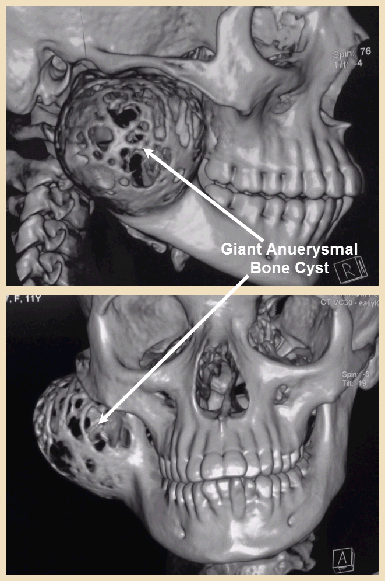
What are Aneurysmal Bone Cysts?
The Aneurysmal Bone Cyst (ABC) of the jaw is a pseudo-cystic lesion lacking an epithelial lining. It is a rapidly growing and destructive bone lesion characterized by replacement of the normal bone with fibro-osseous tissue containing blood-filled sinusoidal / cavernous spaces. Although the ABC is a benign lesion, it can behave locally in an aggressive manner locally because of its rapid growth & osteolytic capacity. This lesion represents less than 1% of all the bone cysts biopsied.
Between 2 – 12% of ABC’s is located at the head and neck region. From this last group almost 90% of the cases affect the posterior mandible (body of the mandible) (40%), ramus (30%), angle (19%), symphysis (9%) and condyles (2%). The median age at diagnosis is 13 years old. 80 % of the patients are under 20 years old.
It is most common in those regions of the skeleton where there is both a relatively high venous and marrow content. This explains the rarity of ABC’s in the skull bones, in which there is low venous pressure.
How are they diagnosed?
The radiological features of ABC’s in the jaws are quite varied.
The bone is expanded, appears cystic resembling a honeycomb / soap bubble & is eccentrically ballooned. There may be destruction / perforation of the cortex and a peri-osteal reaction may be evident.
It may appear radio-lucent, radio-opaque or mixed.
The diagnosis based on radiographic appearance is impossible because there are other lesions having similar radiographic appearance, such as ameloblastoma, myxoma, central giant cell granuloma, odontogenic cysts or central hemangiomas of the bone.
Histologically, ABC’s are characterised by channels & multi-loculated cyst-like spaces filled with blood & lined by fibrous septa that may / may not contain osteoclast-like giant cells, osteoid, woven bone & chondroid matrix material.
What are the signs & symptoms of an Aneurysmal Bone Cyst?
The main symptoms include dull pain ± œdema (swelling). They usually show rapid growth. Depending on its location, other signs / symptoms can be found such as headache, diplopia (double vision), loss of vision (blindness), proptosis (bulging eyes), tooth mobility, hearing loss, etc.
ABC’s can be classified into 3 types.
- Conventional / Vascular type (95%) manifests as a rapidly growing, expansive, destructive lesion causing cortical perforation & soft tissue invasion.
- Solid type (5%) may present as a small asymptomatic lesion first noticed as radio-lucency on a routine X-ray or as a small swelling.
- Mixed variant demonstrates features of both the vascular & solid types. It may be a transitory phase of the lesion because sudden activation / rapid enlargement of stable lesions has been reported.
What are the causes of an Aneurysmal Bone Cyst?
The aetiology of ABC’s are unclear and controversial.
Trauma. Trauma causes an inciting injury to peri-osteal vessels initiating the development of the ABC. However, a history of trauma can be difficult to prove in a large number of cases.
Alteration in Local Hæmodynamics. This causes increased venous pressures and engorgement of the vascular bed in the transformed bone, leading to resorption, connective tissue replacement, and osteoid formation. dilatation of local vascular network due to increased venous pressure caused by local circulatory abnormalities. causing increased venous pressures and engorgement of the vascular bed in the transformed bone, leading to resorption, connective tissue replacement and osteoid formation.
Subperiosteal intra-osseous hæmatoma is a secondary phenomena occurring in primary cystic lesions of bone or tumours.
Reactive malformation
Genetic predisposition. Some researchers have demonstrated that chromosomal translocation t(16;17) (q22; p13) is a cytogenic abnormality which could result in the development of ABCs.
They can arise de novo,when they are known as primary ABC, or in co-existence with other lesions such as ossifying fibroma (OF), chondroblastoma, solitary bone cyst, giant-cell tumour of the bone, osteosarcoma, osteoblastoma, giant cell reparative granuloma, fibrous dysplasia and fibro-myxoma when they are secondary in nature.
Primary could be congenital or acquired and could originate from pre-existing AV malformations. The congenital type is seen in children and young adults with no history of trauma, whereas the acquired type is found in adults with a history of trauma.
The secondary type is postulated to be associated with degeneration of pre-existing lesions such as a cyst, tumour or fibro-osseous lesion. The two lesions could exist independently.
Familial incidence of ABC has also been reported in literature.
How are they treated?
Treatment of ABC is usually directed toward complete removal of the lesion. This may prove difficult at times since the lesions are often multi-locular and may be divided by multiple bony septæ.
The treatment modalities include per-cutaneous sclerotherapy, diagnostic & therapeutic embolisation, curettage, block resection & reconstruction, radiotherapy & systemic calcitonin therapy.
Self-healing cases have also been reported on long-term follow-up.
Several authors recommend immediate reconstruction of the defect with auto-genous grafts in cases of æsthetic deformity, high risk of fractures or loss of mandibular continuity.
Simple curettage is associated with high recurrence rates varying from 21 to 50%.
Differential Diagnosis:
- Ossifying Fibroma
- Ameloblastoma
- Giant Cell Granuloma
- Peripheral & Central Giant Cell Reparative Granulomata
- Traumatic Bone Cyst
- Brown Tumor of Hyperparathyroidism
- Myxoma
- Fibrous Dysplasia
- Desmoplastic Fibroma
- Fibrous Histiocytoma
- Hæmangioma
- Osteogenic Sarcoma
- Globulo-Maxillary Cyst
- Hæmangio-endothelioma
- Hæmangio-pericytoma
Useful Articles & Websites
Head & Face Medicine 2009. Aneurysmal Bone Cyst located in the Mandibular Condyle
J Oral Sci 2011. Case Report. Evolution of an Aneurysmal Bone Cyst – A Case Report
Ann Maxillofac Surg 2012. Giant Recurrent Aneurysmal Bone Cyst of the Mandible
JOMS 2014. Aneurysmal Bone Cyst of the Jaws Clinicopathological Study
J Ind Acad Oral Med Radiol 2015. Bilateral Aneurysmal Bone Cyst of the Mandible – A Case Report