
Exostoses & Tori
What is an Exostosis & Torus?
These are bony swellings that develop in the mouth.
These are not that unusual. They come in a number of shapes, sizes and positions (that is, either in the midline of the roof of the mouth, the tongue side of the lower jaw or the cheek side of both upper and lower jaws).
These bony swellings are given the ‘technical’ names of exostoses or tori.
The torus is considered to be a developmental anomaly, although it does not present until adult life and often will continue to grow slowly throughout life.

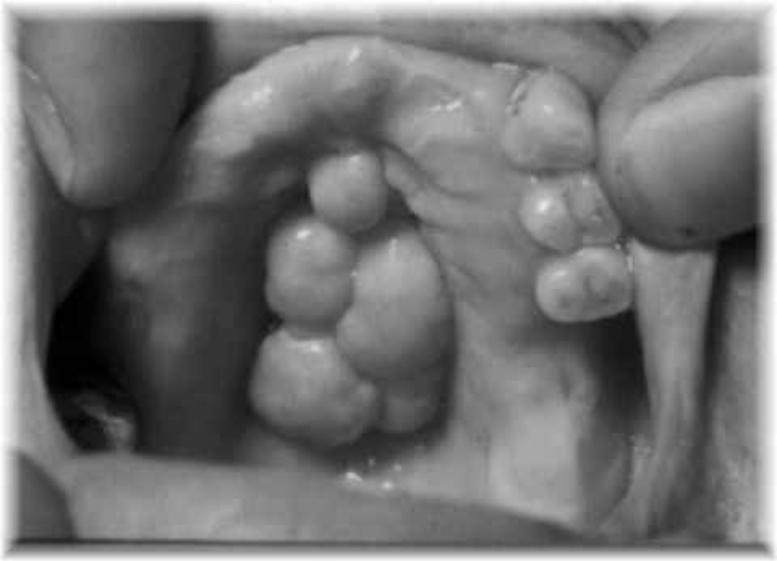
The Torus Palatinus commonly forms towards the back of the hard palate (roof of mouth) in the midline. The swelling is rounded and symmetrical, sometimes with a midline groove. It is not usually noticed until middle age and, if it interferes with the fitting of a denture, it can be removed.
Most palatal tori are less than 2 cm in diameter but their size can change throughout life.
The prevalence of palatal tori ranges from 9% – 60% of the population and are more common than bony growths occurring on the mandible (lower jaw), known as torus mandibularis (ranges from 5% – 40%).
The prevalence rate for tori is 27 / 1,000 adults. These bony lumps are not present until the late teen and early adult years and many, if not most, continue to slowly enlarge over time. Fewer than 3% occur in children. Taken as a group, these bony lumps are found in at least 3% of adults and are more common in females than in males.
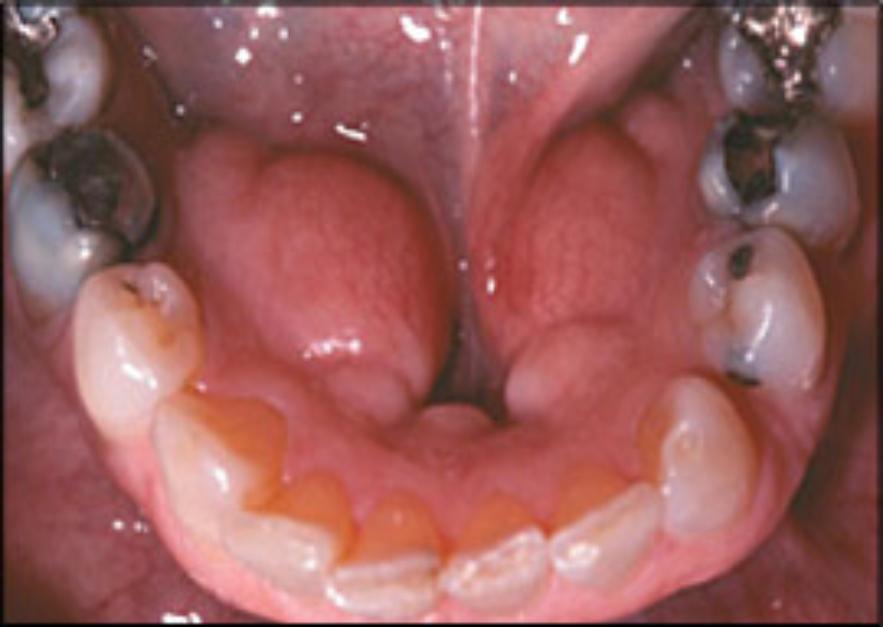
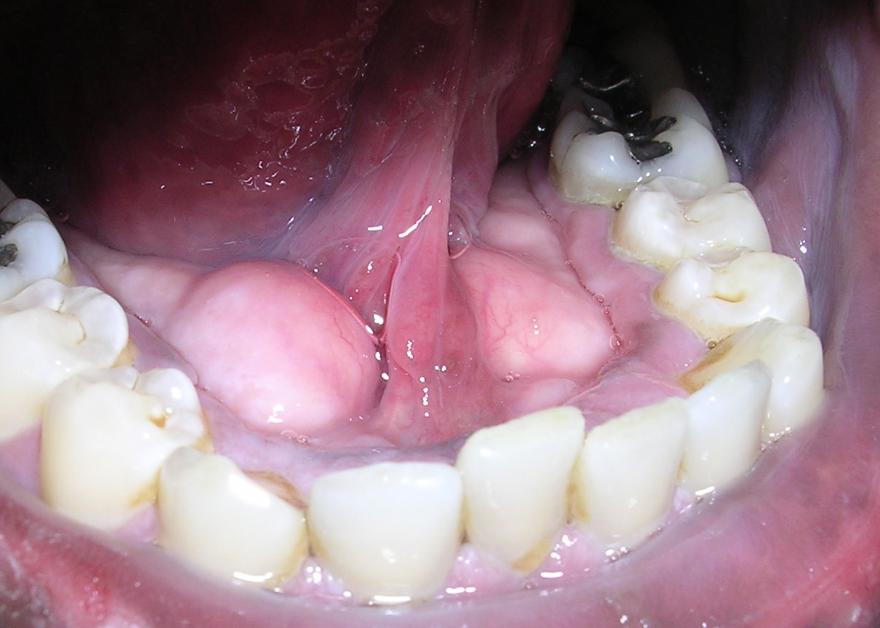
Tori mandibularis form on the tongue-side of the lower jaw, in the region of the premolars / bicuspids (and above the location of the mylohyoid muscle’s attachment to the mandible). They are typically (90% of cases ) bilateral (i.e on both sides) forming hard, rounded swellings. The management is the same as that of the same as that of the torus palatinus.

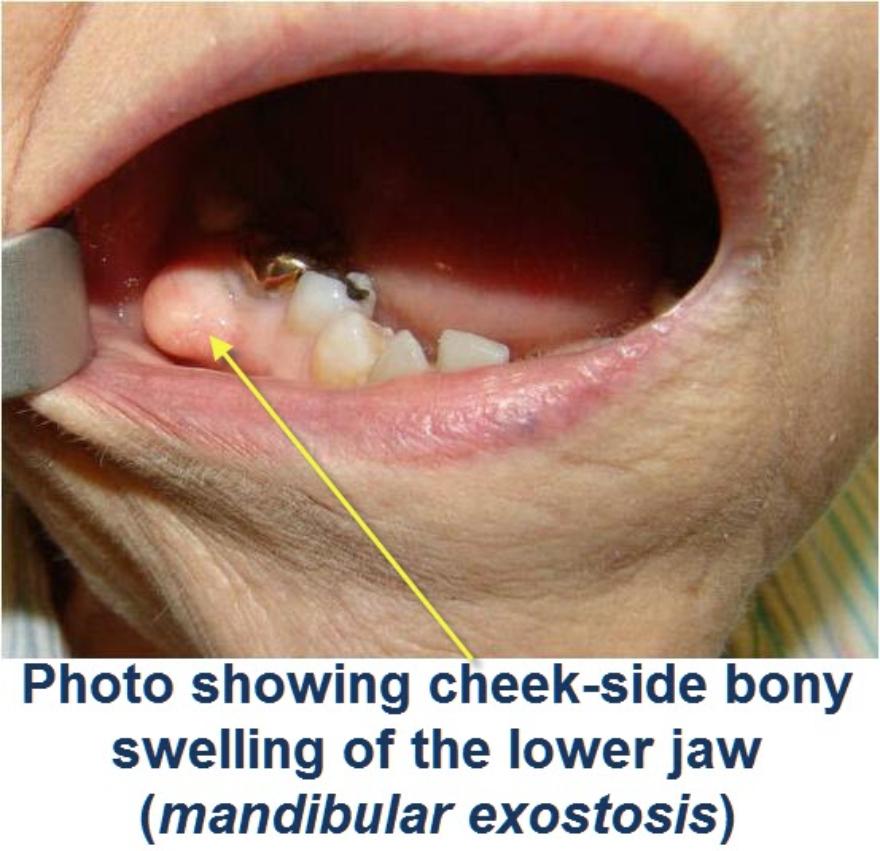

A buccal exostosis is the formation of an exostosis (bone mass) on the outer, cheek-facing side of the maxilla (upper jaw) just above the teeth or the cheek-facing side of the mandible (lower jaw). They are less common on the lower jaw. They begin to develop in early adulthood and may very slowly enlarge over years. They are painless and self-limiting but may contribute to periodontal disease (gum disease / pyorrhoea) if they become too large. They can be removed with surgery. Buccal exostoses have no malignant potential.
Superficial bony masses / lumps found in another site (of the mouth or body) are typically given the catch-all name of exostosis or osteoma. They are considered to be trauma-provoked inflammatory responses or true (benign) neoplasms. Unless such a bony prominence is specifically located, is stalked or is associated with an osteoma-producing syndrome such as the Gardner syndrome, there may be no means by which to differentiate an exostosis from an osteoma, even under the microscope.
What are the signs & symptoms of an exostosis & torus?
Tori can be categorised by their appearance.
Arising as a broad base and a smooth surface, flat tori are located on the midline of the palate and extend symmetrically to either side.
- Spindle tori have a ridge located at their midline.
- Nodular tori have multiple bony growths that each have their own base.
- Lobular tori have multiple bony growths with a common base.
The torus may be bosselated or multi-lobulated but the exostosis is typically a single, broad based, smooth-surfaced mass, perhaps with a central sharp, pointed projection of bone producing tenderness immediately beneath the surface mucosa.
Slowly enlarging, recurrent lesions occasionally are seen, but there is no malignant transformation potential. The patient should be evaluated for Gardner syndrome should there be multiple bony growths or lesions not in the classic torus or buccal exostosis locations. Intestinal polyposis and cutaneous cysts or fibromas are other common features of this autosomal dominant syndrome.
What are the causes of an exostosis & torus?
Tori / buccal exostoses may be the outcome of mild, chronic peri-osteal ischæmia secondary to mild nasal septum pressures (palatal torus) or the torquing action of the arch of the mandible (mandibular torus) or lateral pressures from the roots of the underlying teeth (buccal exostosis) but this is largely speculation.
The most similar bony growth outside the jaws is the bunion of the lateral foot.
They are more common in early adult life and are associated with bruxism (tooth grinding).
The size of the tori may fluctuate throughout life and in some cases the tori can be large enough to touch each other in the midline of mouth. Consequently, it is believed that mandibular tori are the result of local stresses and not solely on genetic influences.
How are they treated?
Neither the torus nor the exostosis requires treatment unless it becomes so large that:
• it interferes with function or denture placement
• suffers from recurring traumatic surface ulceration (usually from sharp foods, such as potato chips or fish bones)
• contributing to a periodontal condition
If removal of the tori is needed, surgery can be done to reduce the amount of bone, but the tori may reform in cases where nearby teeth still receive local stresses.
When treatment is elected, the tori may be chiseled off of the jaw or removed via bone-burr cutting / smoothing through the base of the bony lump.
Useful Articles & Websites
J Cont Dent Practice 2006. Torus Palatinus and Torus Mandibularis in Edentulous Patients
New England J Medicine 2013. Images in Clinical Medicine. Torus Mandibularis
New England J Medicine 2013. Images in Clinical Medicine. Torus Palatinus
JOMS 2013. Oral Tori are associated with Local Mechanical & Systemic Factors. A Case-Control Study